| REGIONS: France: Bordeaux / Gascony |

All About Armagnac
What is Armagnac?
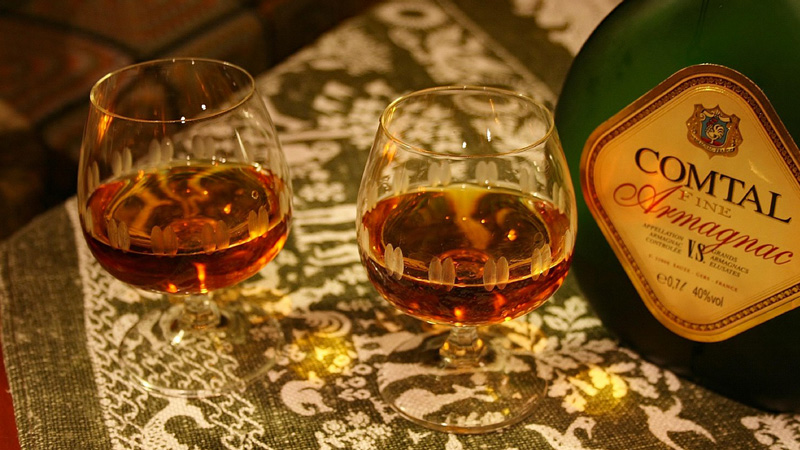
Photo: Pixabay – Donna Senza Fiato
The oldest known type of brandy is Armagnac. It presents as a single-distilled, brown, robust, and full-bodied liquor. Producers typically make it from four types of grape, though they can use a total of ten. Aged in oak barrels, it has a range of tasting notes including grape, fruits, leather, earth, oak, nuts, spices, and baked pastry.
Where is Armagnac Produced?
Armagnac production takes place in the Gascony region of southwest France. The region splits into three districts: Bas Armagnac, Tenareze, and Haut Armagnac.
Often made in small batches by local farmers, Armagnac is not well-known outside of Europe. Local farmers traditionally make this type of brandy as an additional product to top up their annual income from agriculture. For this reason, it receives more care and attention in the production process than its commonly mass-produced cousin, Cognac.
How is Armagnac Made?
The process of distilling wine creates all brandy; however, Armagnac’s unique single distillation preserves aspects of the original wine’s taste, aroma, and texture. Once distilled, they age it in oak barrels.
During the ageing process, some excess water and alcohol evaporates from the liquid in the casks. This process reduces the alcohol content to between 52 and 60%. Once it has reached maturity, the liquid is brown in color and complex in flavor. They remove the spirit from the oak barrels and transfer it to glass bottles for safe keeping.
The wood of the aging barrel and how long Armagnac rests in it shape its flavor, with vintages aging longer than two years. Armagnac flavors depend on the grape variety, the weather, and the terrain.
Discover the History of Armagnac
Experts consider Armagnac to be the oldest type of brandy. Production in France’s Gascony region predated the production of Cognac, by at least two hundred years.
Located in the southwest of France at some distance from the coast, meant that Armagnac production remained local for hundreds of years. Between the 15th and 17th centuries, merchants traded Armagnac in the markets of Saint-Sever, Mont-de-Marsan,and Aire-sur-l’Adour.
By contrast, producers made Cognac 300 kilometers to the north, making Armagnac easier to trade with merchants on the southwest coast of France. At this point, Dutch merchants started trading brandy more widely and financing its production. Merchants used both Armagnac and Cognac as payment for slaves during the triangular trade.
A local peasant farmer patented the very first Verdier still in 1818 which revolutionized the production of Armagnac. Unlike Cognac, which was produced in a large alembic still, Armagnac could be filtered using a lower distillation range. The Verdier still helped to retain the fruity flavor of the grapes and create a more complex and superior brandy. With the Verdier still being more transportable, operators could take it to each small batch grower for individual processing.
By the mid-nineteenth century, local farmers had turned over most of the Armagnac region to production of Armagnac brandy. Trade became easier in the 1850s when two new canals were constructed. Canal de Garonne and Canal de Lalinde connected the isolated region of Armagnac with Bordeaux and the Gironde estuary, which has two ports at its mouth. Local producers were therefore able to increase commerce with passing merchants and make more income.
The prevalence of small-batch production by farmers in Armagnac leads to a diverse selection of this spirit. Each producer uses their own traditional method to make Armagnac, so the flavors of the varieties available differ greatly.
Differences Between Armagnac and Cognac
– Location:
Both Cognac and Armagnac are grape brandies, they are produced in different regions of France. Cognac must be made in the Charente and Charente-Maritime areas to the north of Bordeaux, whereas Armagnac comes from the Gascony region which is to the south of the city.
– Distillation:
Cognac is double-distilled and Armagnac is single-distilled.
– Ageing:
Armagnac is usually aged longer than Cognac, as more time is needed to allow the flavors to integrate and to remove the impurities remaining from the distillation process. Therefore, Armagnac has more body and a fuller flavor than Cognac.
–Production:
Cognac is often made in large batches by big, branded companies, but Armagnac is usually made by small local producers in the traditional way. This can mean a price difference with the final product.
Quick Facts About Armagnac
- France produces only 3 million bottles of Armagnac a year, whereas over 220 million bottles of Cognac are annually exported.
- Armagnac was possibly first referred to in 1310 by Cardinal Prior Vital du Four, who wrote about its “40 virtues”. In those days, Armagnac was often mistaken for other liquors so we can’t be sure.
- In the 18th century, Armagnac was served to courtiers of the French King at the Palace of Versailles.
- Members of the international society which promotes Armagnac are known as musketeers. In 1951, the Compagnie des Mousquetaires d’Armagnac was founded in Gascony, the historical home of D’Artagnan.
- The naming of Armagnac tells you the age. VS (very special) means a mix of brandies that have spent between 1 and 3 years ageing. VSOP (Very Superior Old Pale) is aged from 4-9 years. Napoléon, an intermediate tier, requires a minimum of 6 to 9 years in wood. XO (Extra Old) has a minimum of 10 years of aging aligning with standard brandy premium tiers. Hors d’Âge (beyond age) requires at least 10 years in oak, though cellar masters typically reserve this for much older, elite blends.
- Armagnac Millesime is made exclusively from grapes harvested in a particular year. It must be aged at least 10 years, and then can range up to several decades. Since Armagnac Millesime is based on a single vintage, the taste may vary from year to year.
___________________________
French Hotel Barge Rosa
Rosa is fully air conditioned and accommodates up to 8 guests with two double-bedded and two twin-bedded staterooms, each having ensuite bathrooms. The salon is particularly welcoming and features attractive wood panelling, comfortable seating, and a cosy bar. Outside there is a spacious sun deck with comfortable furniture, a dining area, parasols, and a hot tub.
Rosa

Southwest France, Gascony-Bordeaux
Up to 8 guests
Charters and Cabin cruises
Themed charters:
Family, Wine (Bordeaux)
HOME > REGIONS > All About Armagnac
PARADISE CONNECTIONS
Your Barging Specialists
www.BargeCharters.com
7/27/2026