| REGIONS: Burgundy |

Vézelay
Barging in France: Burgundy
Vézelay has been described as one of the most beautiful villages in France. Located fifty kilometres south of Auxerre, it is situated in the region of Burgundy. The town of Vézelay centers around the Church of St Mary Magdalene and sits on a hill offering stunning vistas of the untouched French countryside. Bordering Morvan Regional Park, Vézelay offers a romantic, untainted experience of France and preserves a wealth of culture, tradition, and history.
The Benedictine Abbey of Vézelay
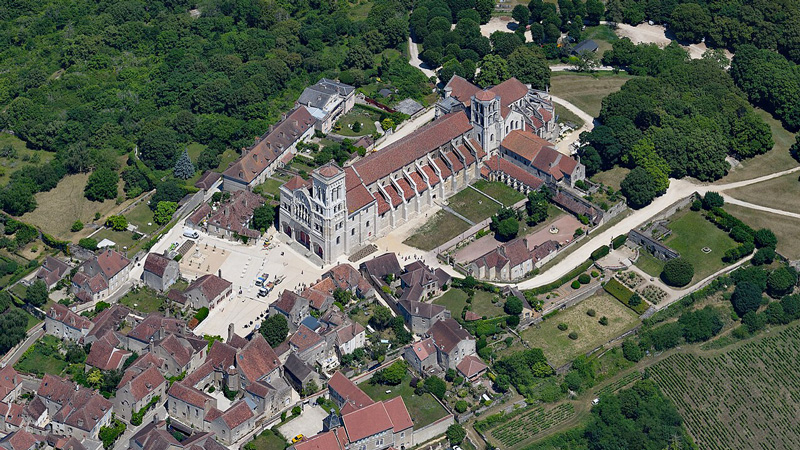
Photo: Wikimedia Commons – carsten steger CC-SA 4.0
The Benedictine Abbey of Vézelay, reputedly the resting place of Mary Magdalene’s remains, gave rise to the town of Vézelay. Built under the instruction of Gerard, Duke of Burgundy, the Church of Mary Magdalene transcends the top of a hill known as the “eternal hill”. Constructed in 771, the abbey’s founders established it to protect holy relics that, according to reports, they rescued from a Muslim invasion of Ephesus in modern-day Turkey.
According to the narrative, the burial remained secret and even the monks themselves did not know about the concealment of Mary Magdalene’s skeleton. Monks rediscovered Mary Magdalene’s remains around 1050, and they spread word throughout France that she was buried at Vézelay. Pilgrims quickly made Vézelay a major pilgrimage site and a convenient stopover on the Way of St. James to Santiago de Compostela.
In 1267, King Louis IX of France examined and authenticated Mary Magdalene’s remains, officially recognizing them for the first time. However, later in the century, Saint-Maximin-la-Sainte-Baume laid claim to having Mary Magdalene’s body, and Charles II of France confirmed the claim. As a result, eventually Vézelay fell out of favor with pilgrims.
The Church of Saint Mary Magdalene in Vézelay
The Benedictine monks built the current Madeleine of Vézelay in the 12th century, leaving the monastic church as the abbey’s only surviving structure. Filled with Romanesque art and architecture, the Church of St Mary Magdalene gives an insight into religion in the 1200s. Its vaulted ceilings, semicircular arches, and imposing pillars make it a stunning example of 12th-century Romanesque architecture
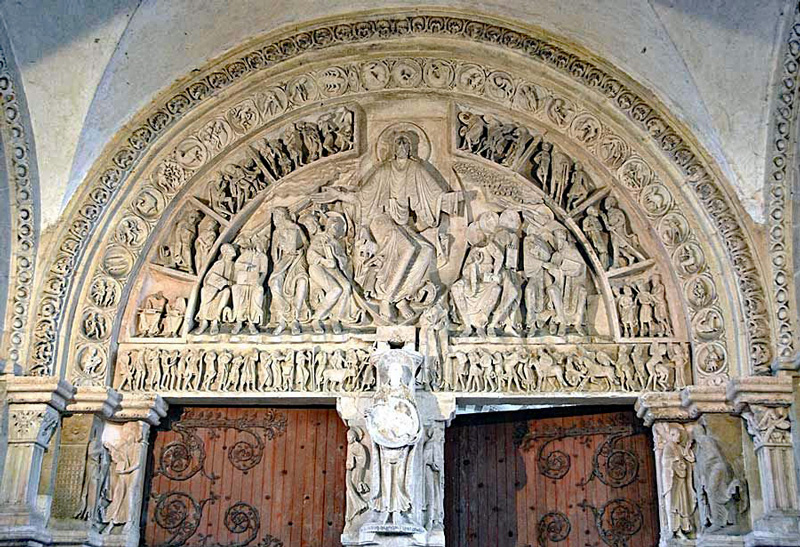
Photo: Wikimedia Commons -zairon CC-SA 4.0
Tympanum of the Narthex Portal
The frieze of the Mission of the Apostles, carved into the tympanum above the interior portal doors, is one of Vézelay Church’s most famous artistic features. The Mission to the Apostles dates from 1120-32 and is a unique example of Romanesque architecture. Centered around Christ, the scene shows Jesus blessing the apostles and telling them to convert the nations. Each of the saints holds a gospel, which is representative of their mission. Medieval depictions of non-Western people surround them. Stories from the First Crusade describe figures with massive ears and show people using ladders to mount their horses.
Revolutionaries destroyed Vézelay abbey in the late eighteenth century and only the Church of the Madeline remained. After the structure succumbed to heavy damage, Eugène Viollet-le-Duc directed its restoration in the 1840s and rebuilt part of its vaults. UNESCO designated the entire village of Vézelay a world heritage site in 1979, due to its historical significance. The authorities protect the whole area surrounding Vézelay church, including the landscape, from any further development.
Guests to the church will find it to be a place of reflection, peace, and calm. Time seems to stand still as you admire the striped vaulted ceilings that soar above your head, making you feel small and insignificant in the presence of a Christian God. This historic spiritual center still inspires so much of the awe and mystique it did when it was first built in the 1100s.
Vézelay and the Crusades
The history of the early Christian crusades intertwines with the Church of Vézelay. From 1095 to the 1500s, Christian-Islamic conflicts and Catholic calls to arms defined the era.
History most closely links Vézelay to the Second and Third Crusades. In 1144, the Muslim ruler of Aleppo and Mosul captured Edessa, which was formerly a part of the ancient Greek territory of Mesopotamia. Pope Eugenius II reacted with rage, since Edessa had been Christian since 325. Consequently, he appealed to Christian rulers for help in 1145. In the following year, St. Bernard preached the Second Crusade at Vézelay, prompting Louis VII and the Frankish armies to unite and go to war.
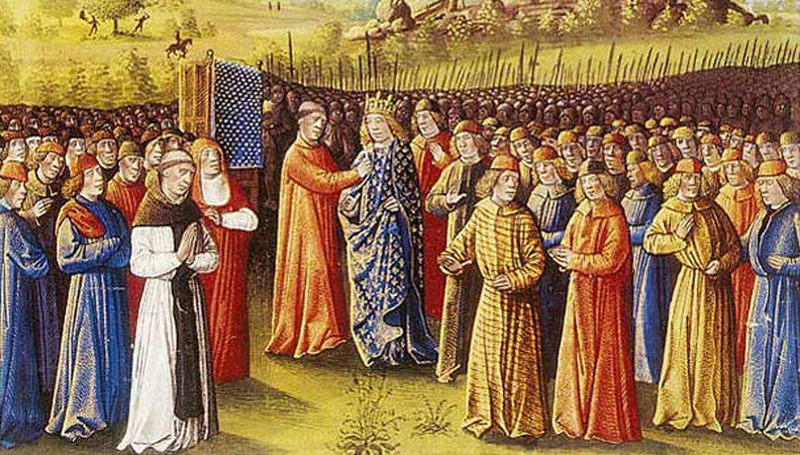
Photo: Wikimedia Commons – sebastian mamerot
The Second Crusade lasted until 1149, despite the Crusaders experiencing a complete disaster during their expedition to the Holy Land. In 1148, the armies of Louis VII and Conrad III of Germany attacked Damascus, the most important city in Syria. Defeat followed quickly when the Catholic army, lacking supplies, retreated after just four days.
The bitter sting of failure for Christians meant that Western troops would not reassemble against Muslims for the best part of another one hundred years. However, following Saladin’s recapture of Jerusalem, the call for a Third Crusade succeeded. At Vézelay in 1190, the English King, Richard the Lion-heart, and French King, Philip II, met to leave for the third crusade. King Richard and Saladin’s treaty allowed unarmed Christian pilgrims and merchants free access to Jerusalem.
The Village of Vézelay
The 12th century village of Vézelay owes its existence to the abbey and church of St Mary Magdalene. One long street defines the historic town, winding around the eternal hill as it climbs to Vézelay church at the top. Entering through the two towers of Porte Neuve, visitors enter onto historic streets lined with medieval buildings and the remains of ramparts.
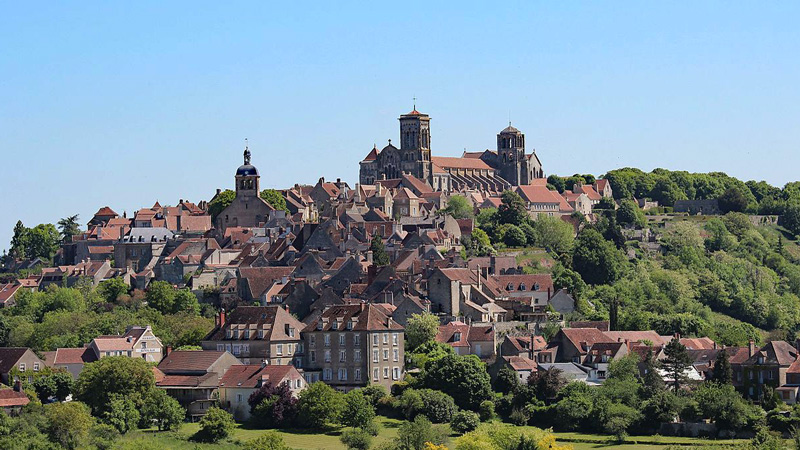
Photo: Wikimedia Commons – Vézelay Office of Tourism CC-SA 4.0
The vibrant village is filled with cafés, galleries and gift shops. Shells left by pilgrims bound for Santiago de Compostela litter the quiet, cobbled streets. On reaching the top of Vézelay, experience extraordinary views of the surrounding landscape, which features picturesque Burgundian vineyards, meadows, and forests.
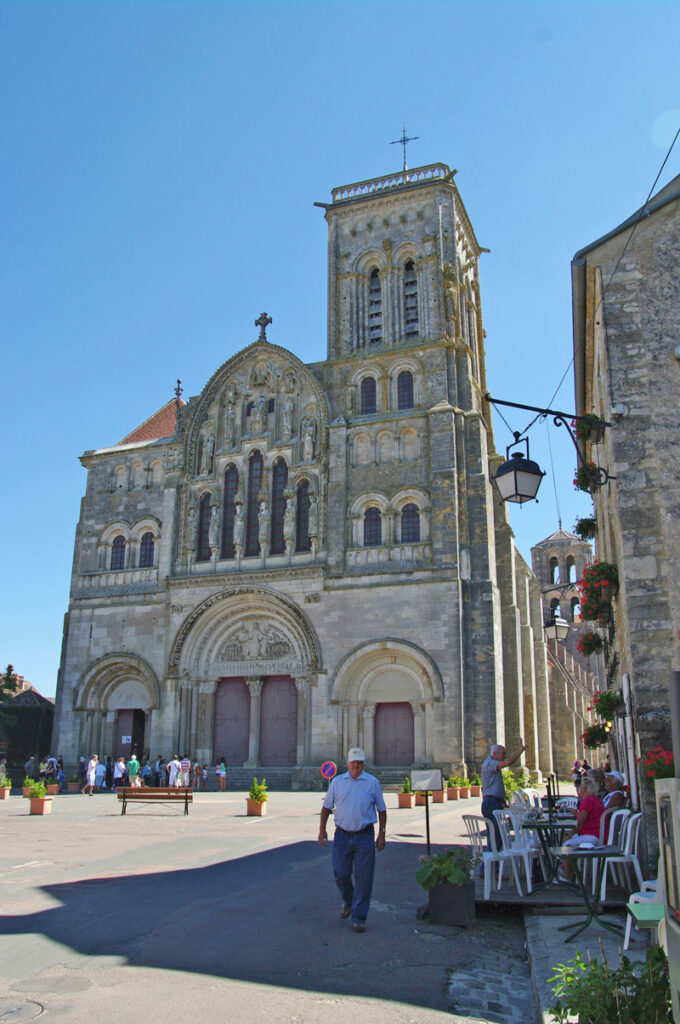
Photo: Wikimedia Commons -cdiguet CC-SA 3.0
Situated on the north side of Vézelay, is the Church of the Holy Cross. Built in 1217 under the instruction of Francis of Assisi, Vézelay became the first French Franciscan establishment. Vézelay was chosen as the location because people preached the Second Crusade there. As Francis was against the crusades, it is likely that he hoped to set brothers to work converting people to Christianity in a non-violent way.
An excursion to explore the château and its spectacular views is a fitting end, or beginning, to the Classic Cruise aboard French Hotel Barge L’Art de Vivre. Whether it is your first taste of Burgundy or a repeat visit to this beautiful region, we’re sure that a trip to Bazoches will not disappoint.
Learn more about the Canal du Nivernais:
- The Canal du Nivernais: An Overview
- The Canal du Nivernais: Towns & Villages
- The Canal du Nivernais: Best Places to Visit
Visit Vézelay aboard L’Art de Vivre
Cruise aboard L’Art de Vivre to enjoy your very own modern-day pilgrimage to Vézelay. After lunch aboard the barge, explore the town at leisure after lunch when moored at nearby Lucy-sur-Yonne. With extravagant cuisine, five-star hospitality, and Burgundy wine served on board, they are an excellent choice to discover Vézelay.
L’ Art de Vivre

Northern Burgundy: Canal du Nivernais
Up to 8 guests
Charters and Cabin cruises
Themed Cruises:
Bike, Family, Wine
HOME > REGIONS > FRANCE > Vézelay
PARADISE CONNECTIONS
Your Barging Specialists
www.BargeCharters.com
5/26/2026