| REGIONS: Burgundy, France |

Barging in Burgundy — Auxerre
Auxerre is the prefecture (capital) of the Yonne department and the fourth largest city in Burgundy. This picturesque city lies on the river Yonne and the Canal du Nivernais. It’s located about 150 km southeast of Paris and 120 km northwest of Dijon.
Auxerre is a beautiful city and a pleasant port, with elegant buildings gracing its waterfront. The city serves as an important religious center and a sizeable market town for timber and wine.
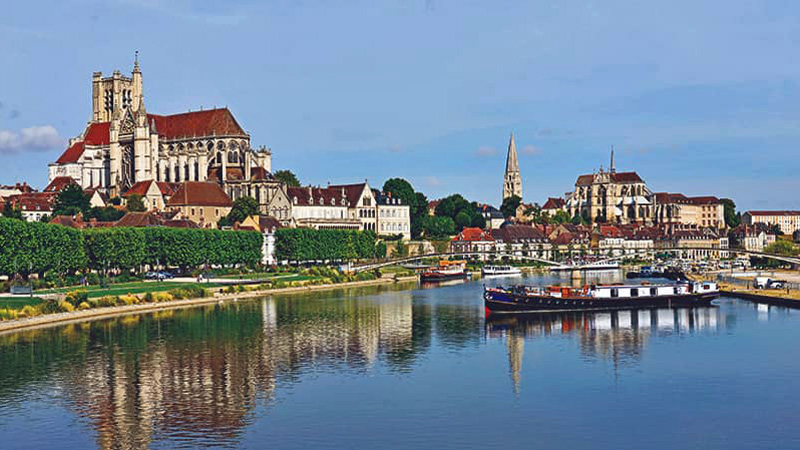
French Hotel Barge L’Art de Vivre in Auxerre
Origins of Auxerre
Originally founded as a Gallo-Romanic settlement, Auxerre gained popularity because of the main road, Via Grippa (1st century AD), that ran through it and crossed the River Yonne. In the 3rd century it became the seat of a bishop and a provincial capital of the Roman Empire. By the 5th century, Auxerre was a thriving town and had its own cathedral.
In the Middle Ages, fortifications encircled Auxerre, forming a closed community that prevented outsiders from entering. The Old Town preserves and showcases Auxerre’s medieval architecture and clock tower. The city prospered during this period and had autonomy under the dukes of Burgundy until it became a part of France under Louis XI.
In the fourteenth century, Auxerre suffered greatly in the wars with England and then again, in the Wars of Religion in the 16th century. In 1567, Protestant Huguenots captured Auxerre and destroyed some of its Catholic architecture. Having fallen on difficult times, Auxerre regained prosperity in the late 1700s through the building of the Canal de Nivernais which increased industry in the city.
Auxerre in More Modern Times
In the 18th century, Auxerre was chosen to link the Canal du Nivernais to the River Yonne. Created to transport firewood, the canal made it easier to travel through the area and increased trade and industry. With the invention of the railway, the commercial use of the canal declined.
The town is now a commercial, industrial, and administrative center. Its varied industries include the manufacture of machinery, electronic equipment, pharmaceuticals, and packaging, as well as food and drink products, including wine, liqueurs, foie gras, and truffles. Auxerre serves as a major production site for Chablis wine, which the Bourgogne-Franche-Comté region produces.
Exploring the Canal de Nivernais by the French Hotel Barge L’Art de Vivre, is an excellent way to to experience Auxerre’s magnificent beauty from the water and view its port, lined with elegant buildings that shine in the summer sunlight.
Places to Visit in Auxerre
Auxerre’s Old Town
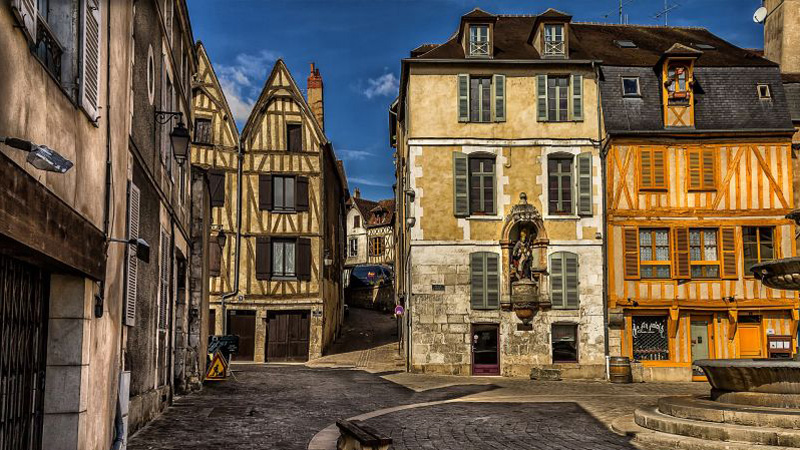
Photo: Pixabay – edmondlafoto
France enjoys an abundance of quaint villages peppered with medieval half-timbered buildings, but it’s in Auxerre that they particularly stand out – flaunting dormer-windows and gabled roofs, with clusters of dwellings opening out onto cobbled squares with fountains. Visitors can easily find their way around the Old Town in Auxerre by following the way-finding arrows on the ground, that direct travellers along the route of the Cadet Roussel trail.
La Tour de l’Horloge (Clock Tower)
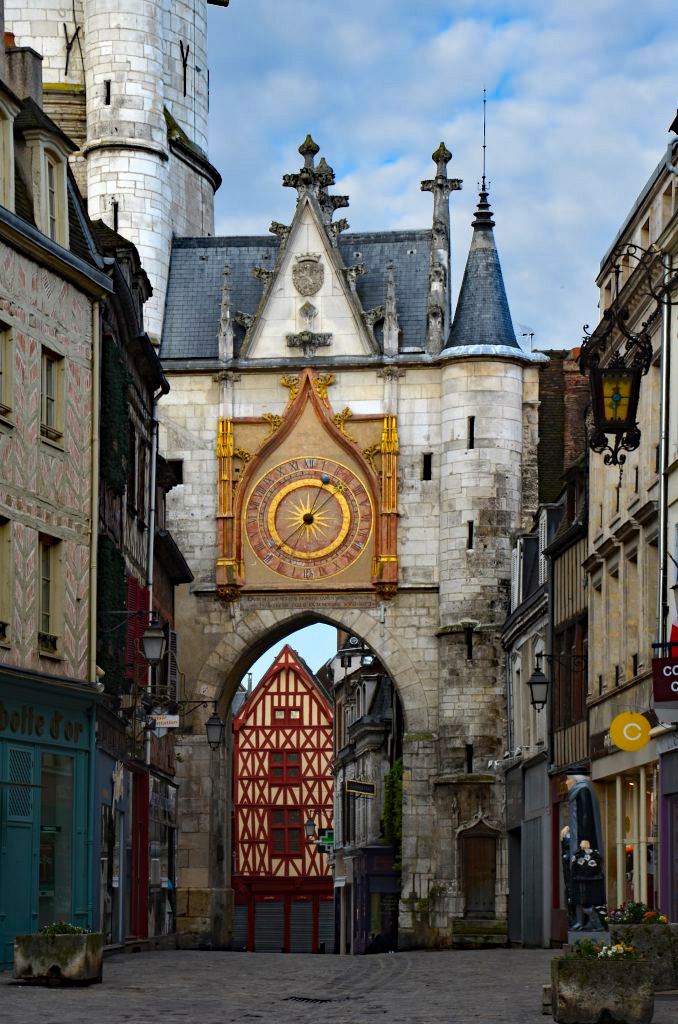
Photo: Pixabay – edmondlafoto
Built in the fifteenth century, this incredible clock contains a mechanism that has worked since 1483. The scientific clock of Auxerre is particularly fascinating because it has two sets of hands: one set to tell the time, and one set to record the lunar phase of the moon. Also interesting is the turreted archway that displays it.
Carolingian Abbaye de Saint-Germain
Founded in the 5th century, the Carolingian Abbaye de Saint-Germain contains the oldest murals in France. Located outside the great walls of Auxerre, the historic monastic complex features dark crypts, classical-inspired cloisters and the tomb of St Germain, who died in the fifth century.
Built on the banks of the River Yonne, Auxerre’s Carolingian Abbey originated as a basilica over the tomb of St Germain. During medieval times, Christian pilgrims visited it in surging numbers, and during the French Revolution, officials demolished the nave so they could use the abbey as a hospital. In 1927, researchers discovered that its 9th-century crypts contained the oldest frescoes in France. These were revealed when work was carried out on the 17th-century plaster in the crypt.
Built in the Gothic style, this 1600-year-old complex is spectacular to behold. The Abbey of St Germain’s spires can be seen throughout Auxerre. Famous historic visitors include the Frankish Emperor, Charles the Bald; and Thomas Becket, the Archbishop of Canterbury.
Cathédrale Saint-Étienne d’Auxerre

Photo: Freepik – Wirestock
Originally built in the Romanesque style, builders updated it in the late medieval period with Gothic brilliance. It is renowned as one of the greatest masterpieces of the Gothic architectural period.
The Auxerre Cathedral occupies a site that has been a place of worship since the third century. Built mostly between the 12th and 13th centuries, this cathedral also features stained glass windows from a later period and art from the 14th, 15th, and 16th centuries.
Cadet Roussel Statue
His real name was Guillaume Joseph Roussel. It is called “Cadet” because he was the middle child of the family. Born in 1743 in the Jura region, he settled in Auxerre in 1763 as a domestic and a lackey, then became a bailiff’s clerk. He then bought a position and became a bailiff himself. Come the Revolution, Cadet Roussel became a Jacobin which was the most influential political club during the French Revolution of 1789. One of his political enemies, the Chevalier Chenu du Souchet, composed the famous song to mock him. That song did not seem destined to spread beyond the boundaries of Auxerre until the Auxerre enlisted men took it with them to the army. The soldiers adopted it enthusiastically and in 1792, it became the marching song of the French Revolutionary Army.
Burgundian wines

Photo: Domaine Laroche
Heading away from the city of Auxerre, are some of the region’s finest vineyards producing popular wines including Crémant de Bourgogne, Saint-Bris, and Chablis. Guests aboard the French Hotel Barge L’Art de Vivre have the opportunity to sample Chablis and Petit Chablis on a private tour and tasting at the prestigious Domaine Laroche, Crémant de Bourgogne at Caves Bailly-Lapierre and, of course, a number of fine regional wines back onboard the barge.
Barging in Auxerre
Experience Auxerre in supreme comfort with a barge cruise on French Hotel Barge L’Art de Vivre. With extravagant cuisine and Burgundy wine served on board with five-star hospitality, they are an excellent choice to discover Auxerre.
L’ Art de Vivre

Northern Burgundy: Canal du Nivernais
Up to 8 guests
Charters and Cabin cruises
Themed Cruises:
Bike, Family, Wine
Learn more about the Canal du Niverais:
- About the Canal du Nivernais
- Towns & Villages along the Canal du Nivernais
- Best Places to Visit on the Canal du Nivernais
HOME > REGIONS > FRANCE > Auxerre
PARADISE CONNECTIONS
Your Barging Specialists
www.BargeCharters.com
5/25/2026