| Barging in Ireland |

Barging in Ireland: An Overview
Shannon River Barge Cruise – Irish Barging Vacations
The island of Ireland consists of 32 counties. The 6 counties to the North comprise Northern Ireland which is part of the United Kingdom, while the remaining 26 counties make up the country of Ireland which gained its independence in 1921. Ireland withdrew from the British Commonwealth in 1948. They joined the European Community in 1973 and their currency is now the Euro.
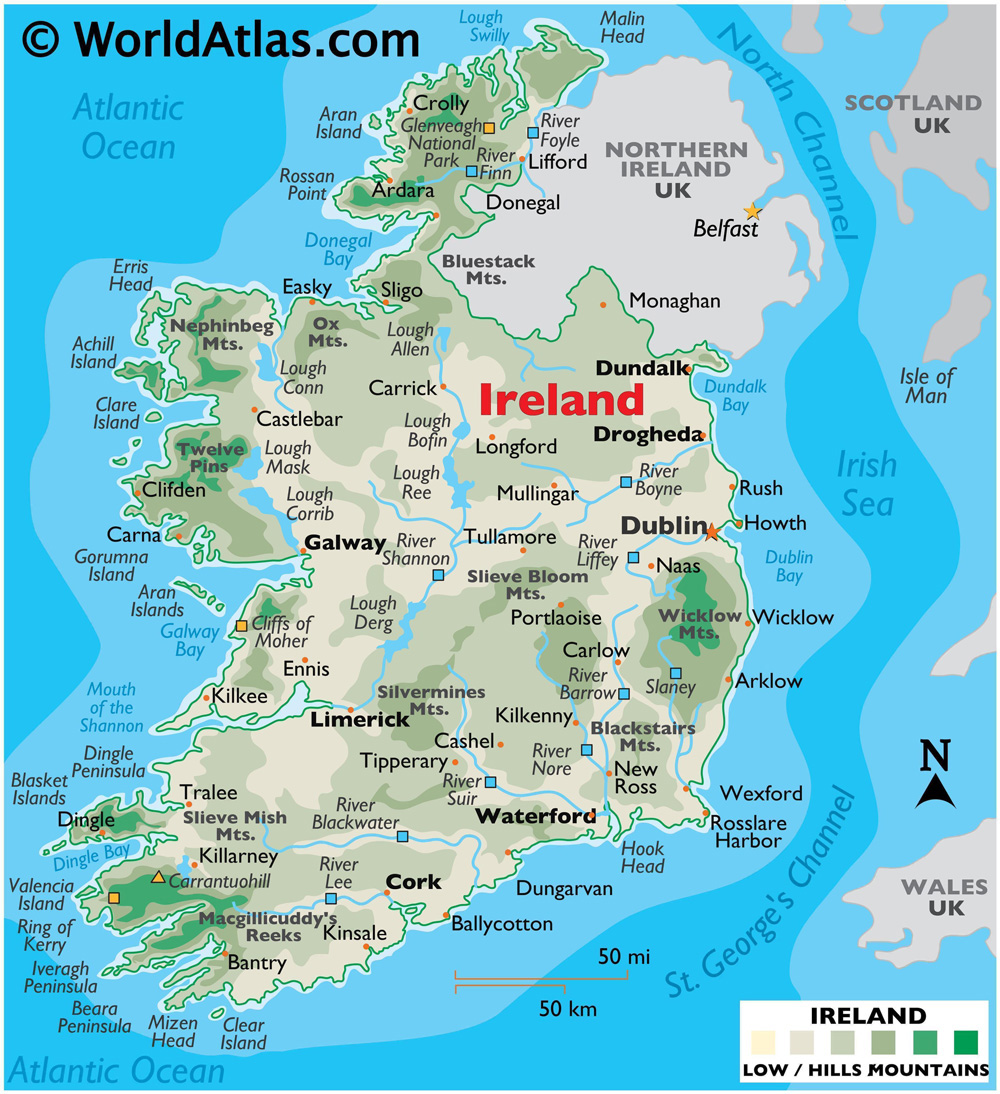
Image: WorldAtlas.com
Map of Ireland
What comes to mind when you hear the word Ireland? 40 shades of green… shamrocks… leprechauns… whisky… Guinness… Joyce… Yeats… U2 ??? By all means, enjoy your Guinness while listening to Bono or The Cranberries, but get a glimpse of the real Ireland from a different point of view while cruising aboard the Shannon Princess II.
☘ Céad míle fáilte ☘
RIVER SHANNON – LOUGH REE – ATHLONE – ATHLONE CASTLE – CORLEA TRACKWAY – SHANNONBRIDGE – CLONMACNOISE – BIRR CASTLE – LEAP CASTLE – GALWAY – PORTUMNA CASTLE – LOUGH DERG – MOUNTSHANNON – KILLALOE – CRAGGAUNOWEN CASTLE – FOYNES FLYING BOAT MUSEUM
The River Shannon
At around 160 miles in length, the River Shannon is the longest river in the British Isles and one of the finest in Europe. Winding through an area of outstanding natural beauty, this unspoiled waterway flows from the Shannon Pot on the slopes of the Cuilcagh Mountains in County Cavan to Loop Head in County Clare, where it meets the Atlantic. Rich in glorious scenery, filled with prolific wildlife, and dotted with pretty villages, the Shannon Erne Waterway is the longest navigable waterway in Europe, and is a paradise for nature lovers, boating enthusiasts and those who prefer the quiet life. The Shannon Princess II cruises the lower River Shannon between Athlone and Killaloe.
Lough Ree
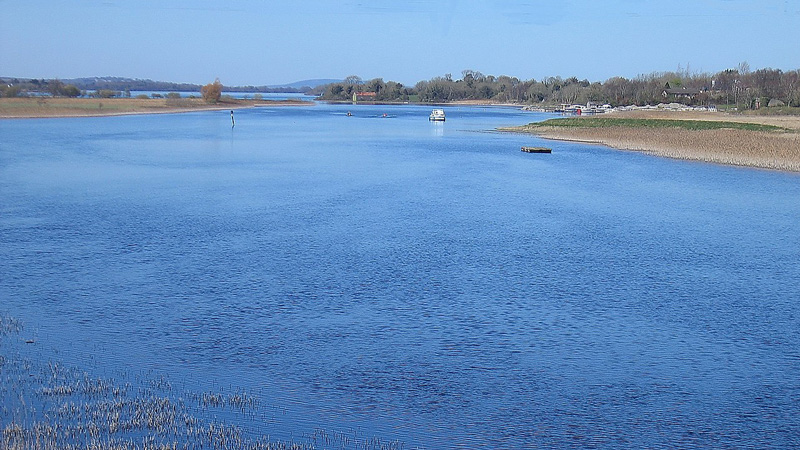
Photo: Wikimedia Commons – Sarah777
Lough Ree
Lough Ree “Lake of Kings” is 16 miles long and is the second largest lake on the River Shannon with numerous islands, bays and inlets offering the adventurous angler wonderful sport. The other two major lakes are Lough Allen to the north, and Lough Derg to the south, there are also several minor lakes along the length of the river. The lake is popular for fishing and boating. The town of Athlone is situated at the southern end of Lough Ree, and has a harbour for boats going out on the lake. The small town of Lanesboro is at the northern end of the lake.
Athlone
Athlone is a vibrant town located in the center of Ireland in the heart of the Lakelands Region on the banks of the River Shannon. Athlone owes its existence to its location as the principal crossing point on the Shannon. The town links the east of Ireland to the west, and the river provides an artery of communication with Munster and Ulster. In early times, Athlone was known as “An Sean Ath Mor”, or the Great Ford of Antiquity. The modern name of Athlone comes from the two Irish words, “Ath” meaning ford or crossing, and “Luan” a man’s name and means the Ford of Luan.
– Athlone Castle
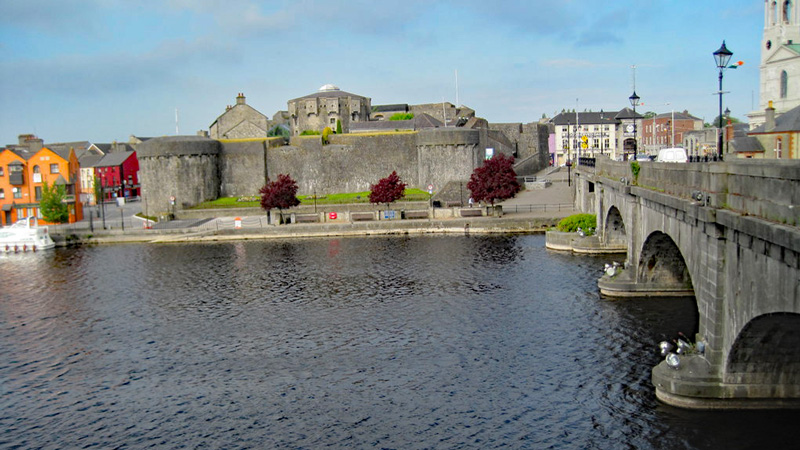
Photo: Wikimedia Commons – Nigel Thompson CC-SA 2.0
Athlone Castle
This 13th-century Norman castle dominates the town and was central to the siege of Athlone in 1691. Today the castle is a center of tourism housing the tourist office, a visitors center, a museum and a specially commissioned tribute to the world famous tenor, John Count McCormack. Other features include exhibitions on the siege of Athlone, River Shannon wildlife and history, together with folklore and military museums.
– Corlea Trackway Visitor Centre
The Corlea Trackway Visitor Centre interprets an Iron Age bog road that was built in the year 148 B.C across the boglands of Longford, close to the River Shannon. The oak road is the largest of its kind to have been uncovered in Europe and was excavated by Professor Barry Raftery of University College Dublin. Inside the interpretative centre, an 18-meter stretch of the preserved trackway is on permanent display in a hall specially designed to preserve the ancient wooden structure. Bord na Móna and the Office of Public Works have carried out conservation work on the surrounding bog to ensure that it remains wet and that the buried road remains preserved.
Shannonbridge
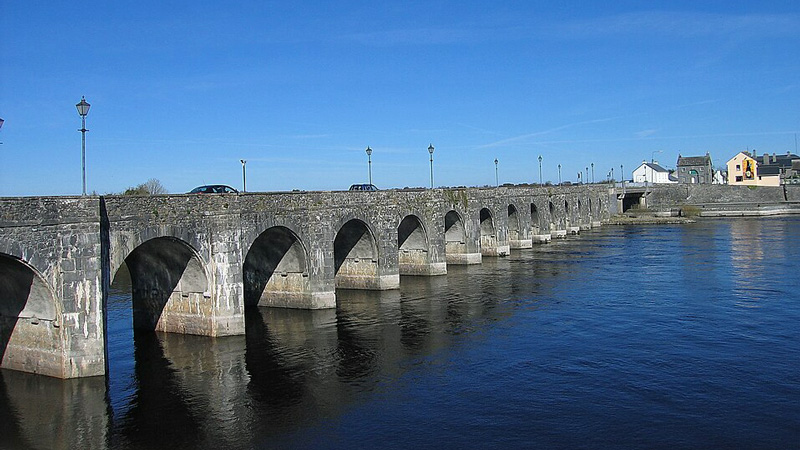
Photo: Wikimedia Commons – Sarah777
Shannonbridge
Shannonbridge gets its name from its bridge connecting county Offaly and county Roscommon. “Rachra” is generally considered the old name for Shannonbridge, but “Shannonbridge” was adopted after the building of the bridge in 1757. It is said that the military initially constructed a village, the “first Shannonbridge”, in the vicinity of Temple Duff graveyard. The name Temple Duff is probably an anglicised version of Teampaill Dei – “Church of God”. Like many other early Christian sites, Temple Duff eventually became a burial site for unbaptised children. The tracks of 14 houses and the remains of a stage or post chase are located in the area. At Curleys Island between Shannonbridge and Clonmacnoise, we encounter the legendary ford of Snamh da Ean (swim two birds). It was here that a proselytising St. Patrick crossed the Shannon into Connacht and much later the Anglo-Normans considered the ford important enough to be guarded by one of their campaign forts. Accordingly, they constructed the great Motte of Clonburren on the Roscommon side of the river, within sight of an even then declining early Christian nunnery, which is presumed locally to have been founded by St. Patrick. The renowned monastic settlement of Clonmacnoise is about 7 km upriver. Shannonbridge is a particularly popular destination for angling.
– Clonmacnoise

Photo: Pexels – Rev Lisa J Winston
Clonmacnoise
This early Christian site was founded by St. Ciarán in the mid-6th century on the eastern bank of the River Shannon. Clonmacnoise was a great center of learning, and many manuscripts, including the Annals of Tighernach (11th century) and the Book of the Dun Cow (12th century), were written here. The site includes the ruins of a cathedral, seven churches (10th-13th century), two round towers, three high crosses and the largest collection of Early Christian graveslabs in Western Europe. The visitor center has a display of original high crosses and a selection of graveslabs. The long and varied history of Clonmacnoise is recounted in an audiovisual presentation, and there are also exhibitions that deal with the flora, fauna and landscape of the region.
– Birr Castle
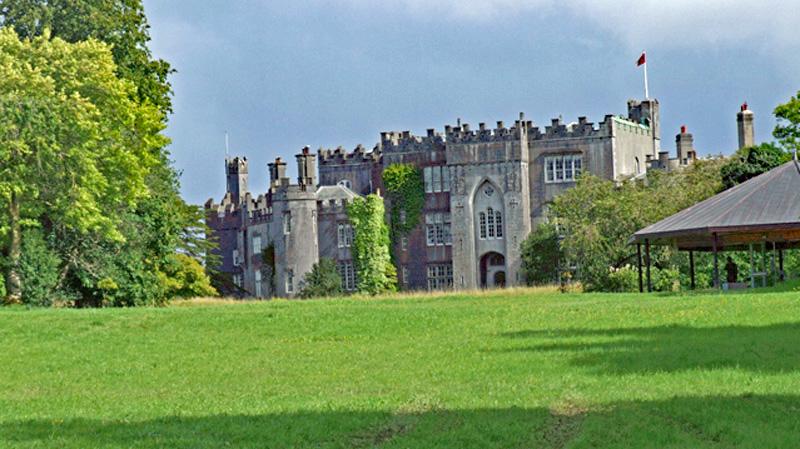
Photo: Wikimedia Commons – Dennis Turner CC-SA 2.0
Birr Castle
The Birr Castle Demesne (or Estate) offers something for everyone to enjoy and is especially interesting and educational for families. Start with Ireland’s Historic Science Centre in the old stable block, along with its café and shop. Then explore 50 hectares of park land, visit the magnificent Formal Gardens and terraces, and discover Birr’s world famous engineering and astronomical wonder… the Great Telescope. A “demesne” consists of the lands held by an estate for its own use and occupation, incorporating gardens, farmlands, woods and buildings.
The Gardens have a rich history attached to them. They were originally landscaped around the lake in the 18th century by Sir William Parsons, and over the generations of the Parsons family the Demesne has increased in beauty and interest. It now has plant material collected and subscribed for by three generations of the Earls of Rosse, as well as some of the most famous plant hunters past and present. The garden comes alive in spring with spring flowering bulbs and a vast Magnolia collection.
Ireland’s Historic Science Centre contains astronomical instruments, cameras, photographs and photographic equipment used by the Third and Fourth Earls and Mary, Countess of Rosse, in the middle and late 1800s. Also on display is electrical and engineering equipment originally belonging to Charles Parsons and used in his experiments as well as a large area devoted to the botanical work carried out in the Demesne. The whole collection is housed in the restored stables of the castle.
The Great Telescope (aka The Rosse Telescope). During the 1840’s and starting from virtually first principles, the third Earl of Rosse designed and had built the mirrors, tube and mountings for a 72-inch reflecting telescope which was the largest in the world at that time and remained so for three quarters of a century. With this instrument, situated near the middle of Ireland, Lord Rosse was able to study and record details of immensely distant stellar objects and to provide evidence that many of these mysterious nebulae were actually galaxies located far outside our own.
Leap Castle
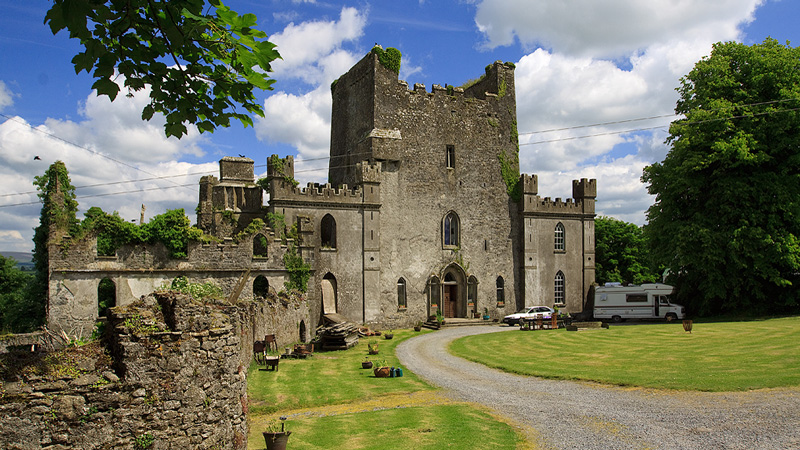
Photo: Wikimedia Commons – Mike Searle CC-SA 2.0
Leap Castle
Leap Castle stands on an ancient rock near the town of Birr in County Offaly, guarding a strategic pass through the Slieve Bloom mountain range. It was built in the late 15th century by the O’Bannon family and was originally called “Léim Uí Bhanáin,” or “Leap of the O’Bannons.” The O’Bannons were the “secondary chieftains” of the territory, and were subject to the ruling O’Carroll clan. This is a site of much violence, murder, and mayhem. Many people were imprisoned and executed in the castle, and it is supposedly haunted by several spectres. It is reported to be the most haunted castle in Ireland. While renovating the castle, workers discovered an oubliette, a dungeon where people are locked away and left to die. There are spikes at the bottom of this shaft, and when it was being cleaned out, it took three cartloads to carry out all the human bones at the bottom.
Sean Ryan, the owner of Leap Castle in Ireland, discusses the spirits that cohabitate in Leap Castle with his family
In 1991, the musician Sean Ryan purchased the castle and is currently living there while undertaking restoration to make it into a family home. In fact, their baby daughter was christened in Leap Castle’s Bloody Chapel which was described as a “happy, pleasant, wonderful day”, filled with music, dancing, laughter, and most of all love.
Galway City
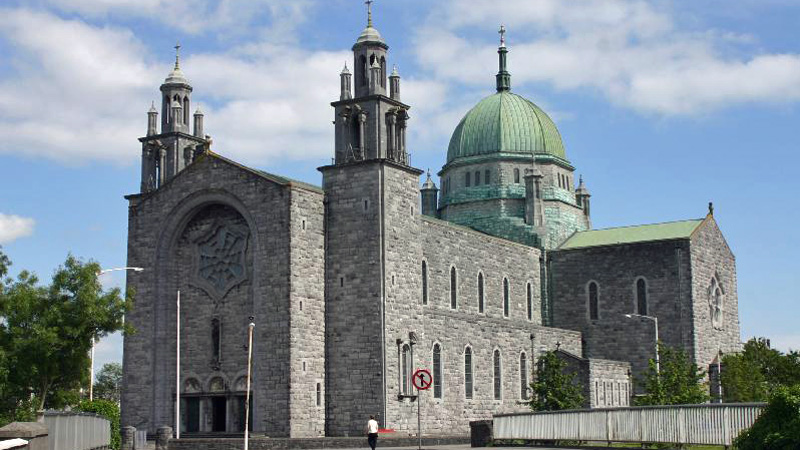
Photo: Wikimedia Commons – unknown CC-SA 3.0
Galway Cathedral
The City of Galway is the third largest and fastest-growing city in the Republic of Ireland. Located on the west coast, it sits on the River Corrib between Lough Corrib and Galway Bay. Galway is known as Ireland’s Cultural Heart and is renowned for its vibrant lifestyle, numerous festivals, celebrations and events.
Galway has a reputation amongst Irish cities for being associated with the Irish language, music, song and dancing traditions. It is sometimes referred to as the ‘Bilingual Capital of Ireland’, although like all other cities in the Republic of Ireland, the vast bulk of the city’s inhabitants converse mostly in English.
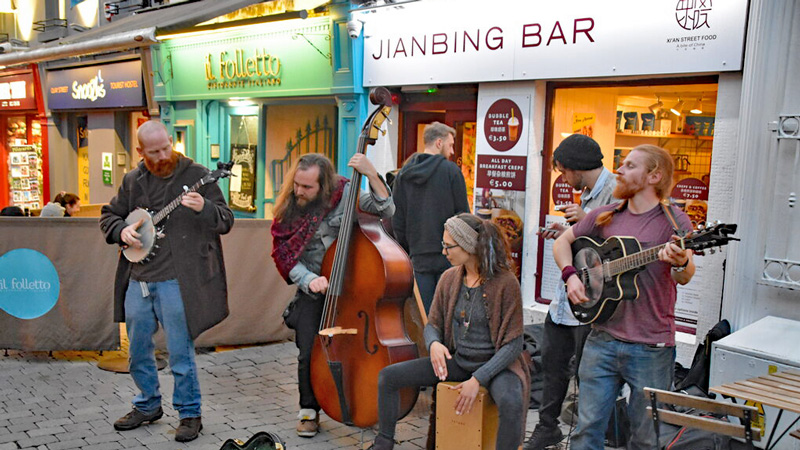
Photo: Wikimedia Commons – N.Chadwick CC-SA 2.0
Galway Street Musicians
The city has a vibrant and varied musical scene. As in most Irish cities, traditional music is popular and is kept alive in pubs and by street performers. Every July, Galway hosts the Galway Arts Festival which was first held in 1978 and since then has grown into one of the biggest arts festivals in Ireland. It attracts international artists as well as providing a platform for local and national performers. The festival features parades, street performances and plays, musical concerts and comedy acts. Highlights of the festival tend to be performances by Macnas and Druid, two local performance groups.
You can find a bit of everything here… two universities, many museums, arts & crafts, historical sites… so much to see and do.
Interested in pubs? Visit the Galway Tourism: Guide to the Pubs in Galway City and County and study up before you go.
Portumna Castle & Gardens
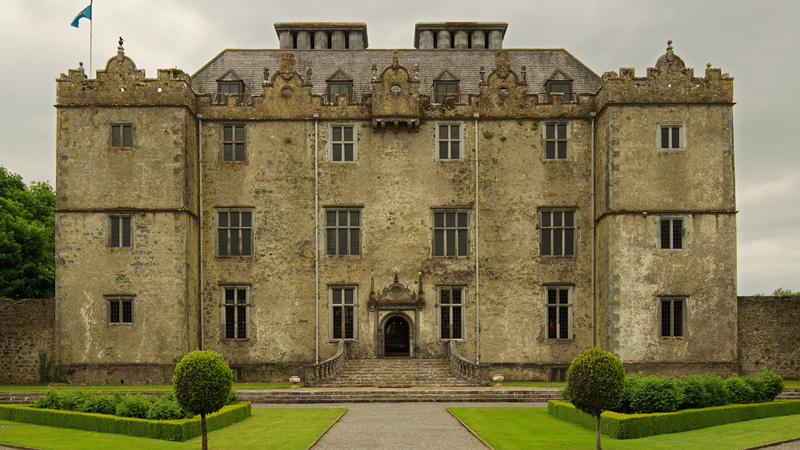
Photo: Wikimedia Commons – Mike Searle CC-SA 2.0
Portumna Castle
The great semi-fortified house at Portumna was built sometime before 1618 by Richard Burke, or de Burgo, 4th Earl of Clanricarde. It was the main seat of the de Burgo family for over 200 years, until it was gutted by fire in 1826. The ground floor of the house is now open to the public.
To the north of the castle are formal, geometrically laid out gardens which include the wonderfully restored 17th century walled kitchen garden. Following its original plan, the garden has been organically planted with fruit trees, flowers, herbs and vegetables.
The castle’s surrounding woods and parklands were taken over in 1948 by the Forestry Service and are now a wildlife sanctuary. Conservation and restoration on the building and immediate grounds began when they were acquired by the Office of Public Works in 1968. Restoration work on the castle is ongoing with the first floor of the three-floor building open to the public. Exhibitions on the ground floor tell the history of the castle and of the de Burgo family. The extensive walled 17th century kitchen garden and the formal gardens have been completely restored and are open to the public. Located within the precinct of the castle, there are also ruins of a Dominican Friary built circa 1425 and destroyed in 1540. Portumna Castle is surrounded by the town’s local attractions: Lough Derg, the River Shannon and Portumna Forest Park.
Lough Derg
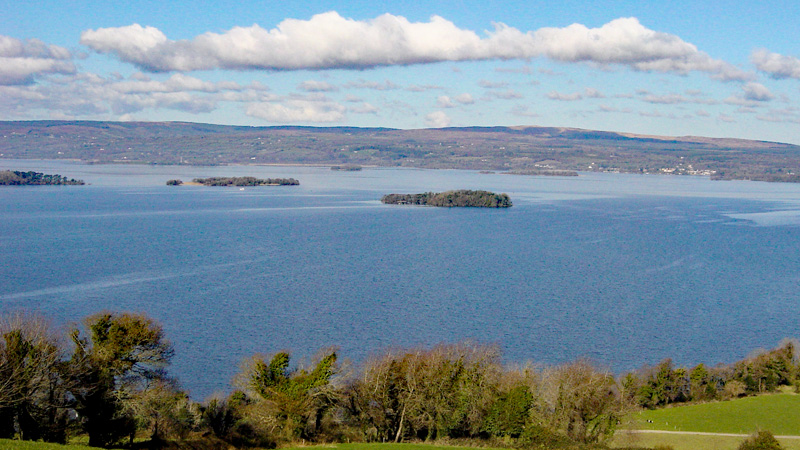
Photo: Wikimedia Commons – Ludraman CC-SA 3.0
Lough Derg
Lough Derg (Loch of the Red Eye) is the second largest lake in the Republic of Ireland. It is a long, relatively narrow lake, with shores in counties Clare, Galway, and North Tipperary. Some towns or villages on Lough Derg include Garrykennedy, Portumna, Killaloe & Ballina, Dromineer, Terryglass and Mountshannon. At its deepest, the lake is 120-feet deep and covers an area of about 45 square miles. At the point where Lough Derg empties into the Shannon, it slopes steeply downhill which was a major reason for the location of the world’s then-largest hydroelectric power plant at Ardnacrusha in 1927. In the nineteenth century, Lough Derg was an important artery from the port at Limerick to Dublin through the canals in the midlands of Ireland. Navigable over its full 25-mile length, today Lough Derg is popular with cruisers and other pleasure traffic, as well as sailing and fishing. The University of Limerick has an activity center by the lake, just outside Killaloe. It is used for canoes, kayaks, windsurfing and yachts, among other purposes. There is another “Lough Derg” in County Donegal.
Mountshannon
Mountshannon is a village in east County Clare, Ireland. The village is on the western shore of Lough Derg, north of Killaloe. It is said that the largest oak tree in Ireland is in Mountshannon, as well as a number of lovely pubs. Other items of note is that the village of Mountshannon was a past winner of the Irish Tidy Towns Competition, and was also home to the last manually operated telephone exchange in Ireland. The exchange was finally converted to automatic service in May 1987. A recent addition to Mountshannon is the maze built in the center of town in a very well maintained small park, with lovely views of Lough Derg. The maze features information about the development of traditional art in Ireland. Next to the maze is a picnic area made out of wood carved by local artists. In the entrance is a stone with a hole facing toward Holy Island. To the rear of the maze is a fine turf labyrinth similar to the pavement labyrinth at Chartres Cathedral in France.
Killaloe
Killaloe is a village located on the eastern border of County Clare on the southern tip of Lough Derg on the Clare-Tipperary border 18 miles northwest of Limerick City.
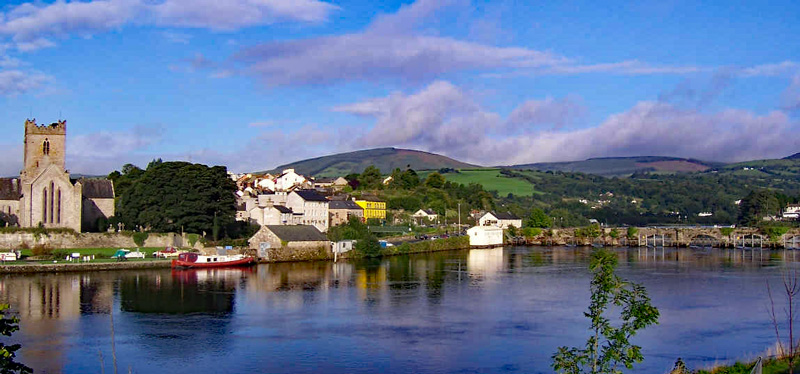
Photo: Wikimedia Commons – Chris55
Killaloe
The linked towns of Killaloe and Ballina offer history, a beautiful riverside setting, and access to the Shannon waterway. Killaloe was the birthplace of Brian Boru, Ireland’s famous High King, and he ruled the Kingdom of Ireland from here. There is a festival in his honor every year at the end of June. Killaloe is one of the principal crossings on the River Shannon, making it a strategic spot for defense and trading, as a result the area is rich in history and archaeology. In the tenth century it was base for Brian Boru as it controlled the strategic crossing of the Shannon above Limerick, where the Vikings were in control. Nowadays, a 13-arched stone bridge separates the towns.
Killaloe, is a network of charming narrow streets, flanked by old shops and houses, that climb up the steep hillside and look down over the 13th century St Flannan’s Cathedral. There are numerous remains of monastic settlements, four old chapels, and a 90-foot round tower. The picturesque eighteenth century style harbour village of Mountshannon lies just to the north of Killaloe on the Shannon.
Craggaunowen Castle
The name Craggaunowen derives from its Irish name Creagán Eoghain (Owen’s little rocky hill).
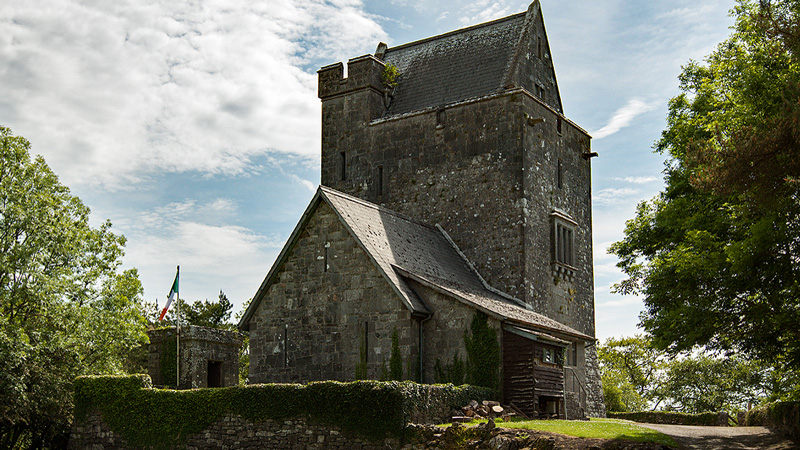
Photo: Wikimedia Commons – Mike Searle CC-SA 2.0
Craggaunowen Castle
– Craggaunowen Castle was built in 1550 by John MacSioda MacNamara, a descendant of Sioda MacNamara who built Knappogue Castle in 1467. It is a typical example of a fortified Tower House which was the ordinary residence of the gentry at the time. After the collapse of the Gaelic Order in the 17th century, the castle was left roofless and uninhabitable. “Honest” Tom Steele had the castle rebuilt as a summer house in the 1820s. The modern restoration work was completed in 1965 by John Hunt, who then added the extension to the ground floor in 1967 where part of his collection of antiquities containing many medieval objects were exhibited. Most of his collection now resides in the Hunt Museum in Limerick City. Some larger items of furniture still remain at Craggaunowen Castle.
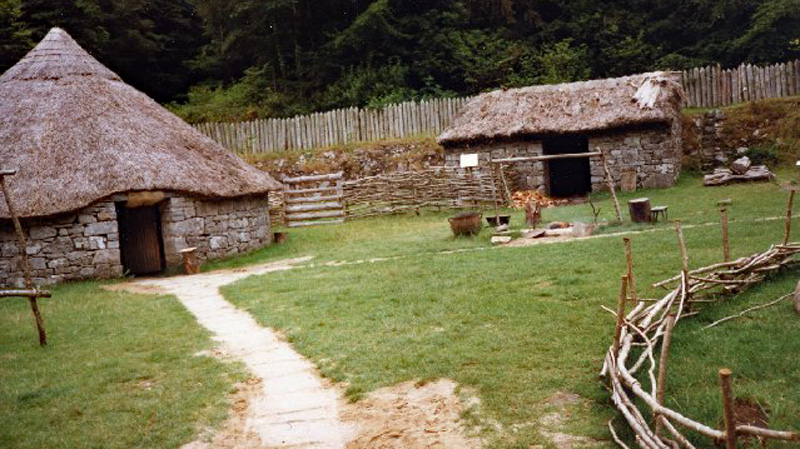
Photo: Wikimedia Commons – Mike Searle CC-SA 2.0
Bronze Age Hut
– The Craggaunowen Project is an award winning archaeological open air museum centered around a 16th Century Towerhouse in County Clare Ireland.
The park, started by John Hunt, is set in 50 acres of idyllic woodland with a picturesque lake and is host to several examples of early historic dwelling places. The Park interprets several features commonly found in the Irish archaeological landscape, by the recreation of several homesteads and monuments. The primary features are a Crannóg which is a type of man-made island dwelling place that came into being in the Bronze Age with some showing usage through to 17th Century, with their main usage being around the 7th Century); a Ring Fort (these also show evidence of having similar period coverage to the Crannógs); a replica Fulachta Fia (Bronze Age cooking and/or industrial site); a Dolmen (Neolithic Portal tomb) and Standing Stone.
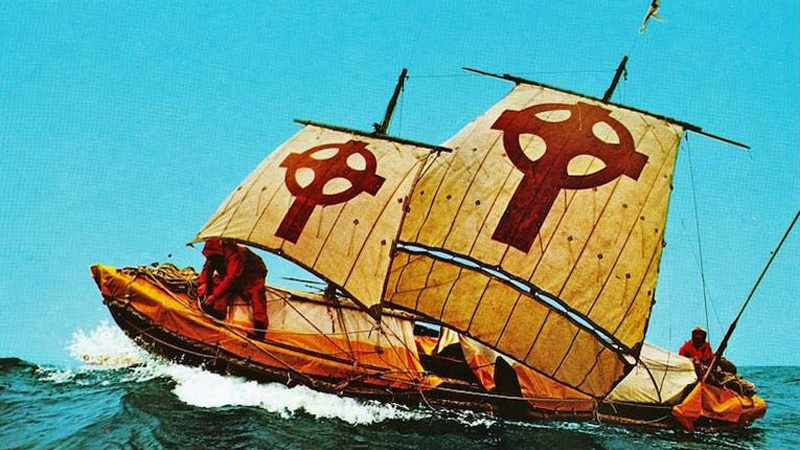
Photo: Cotton Coulson – OurIrishHeritage.org
The Brendan Boat
– The Brendan Boat is another important attraction at Craggaunowen.
Tim Severin sailed this hide boatfrom Ireland to Canada, re-enacting the Voyage of St. Brendan the Navigator (who died in 583 AD) who is reputed to have discovered America centuries before Columbus. The actual boat used in Severin’s qwest is on display in a specially constructed glass boathouse.
Foynes Flying Boat Museum
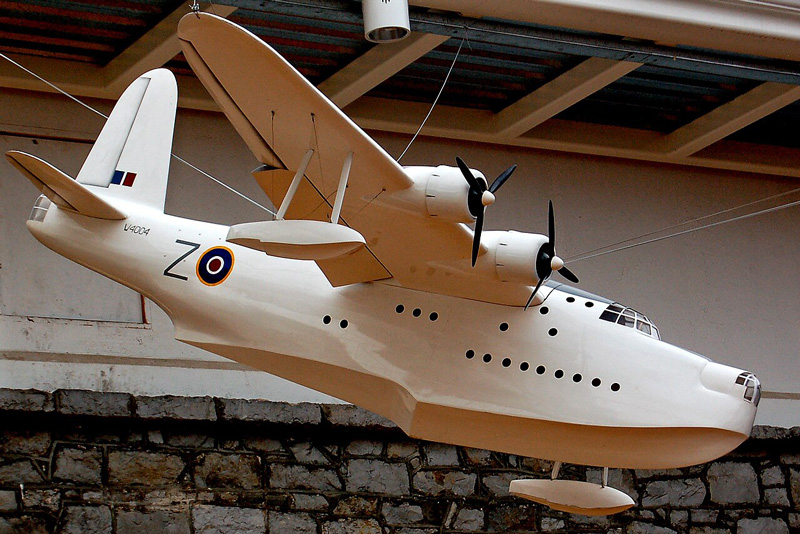
Photo: Wikimedia Commons – Joseph Mischyshyn CC-SA 2.0
Foynes Flying Boat Museum
The Foynes Flying Boat Museum housed in the original terminal building in Foynes, recalls that nostalgic era when Foynes became the center of the aviation world from 1937 to 1945.
This amazing story is told through a comprehensive range of exhibits and graphic illustrations featured throughout the original Terminal Building including in our authentic 1940’s cinema; the Radio and Weather Rooms–complete with transmitters, receivers and Morse code equipment; the Brendan O’Regan restaurant and of course, the only full sized replica B314 flying boat.
Learn more about Ireland
- Towns, Villages, and Places to Visit along the River Shannon
- Tour the Ancient Clonmacnoise Ruins
- More links for Ireland
Barges that offer Irish Barge Cruises
Shannon Princess

Lower Shannon River
Up to 10 guests
Charters and Cabin cruises
Themed charters:
Family, Golf
HOME >REGIONS >IRELAND > An overview
PARADISE CONNECTIONS
Your Barging Specialists
www.BargeCharters.com